
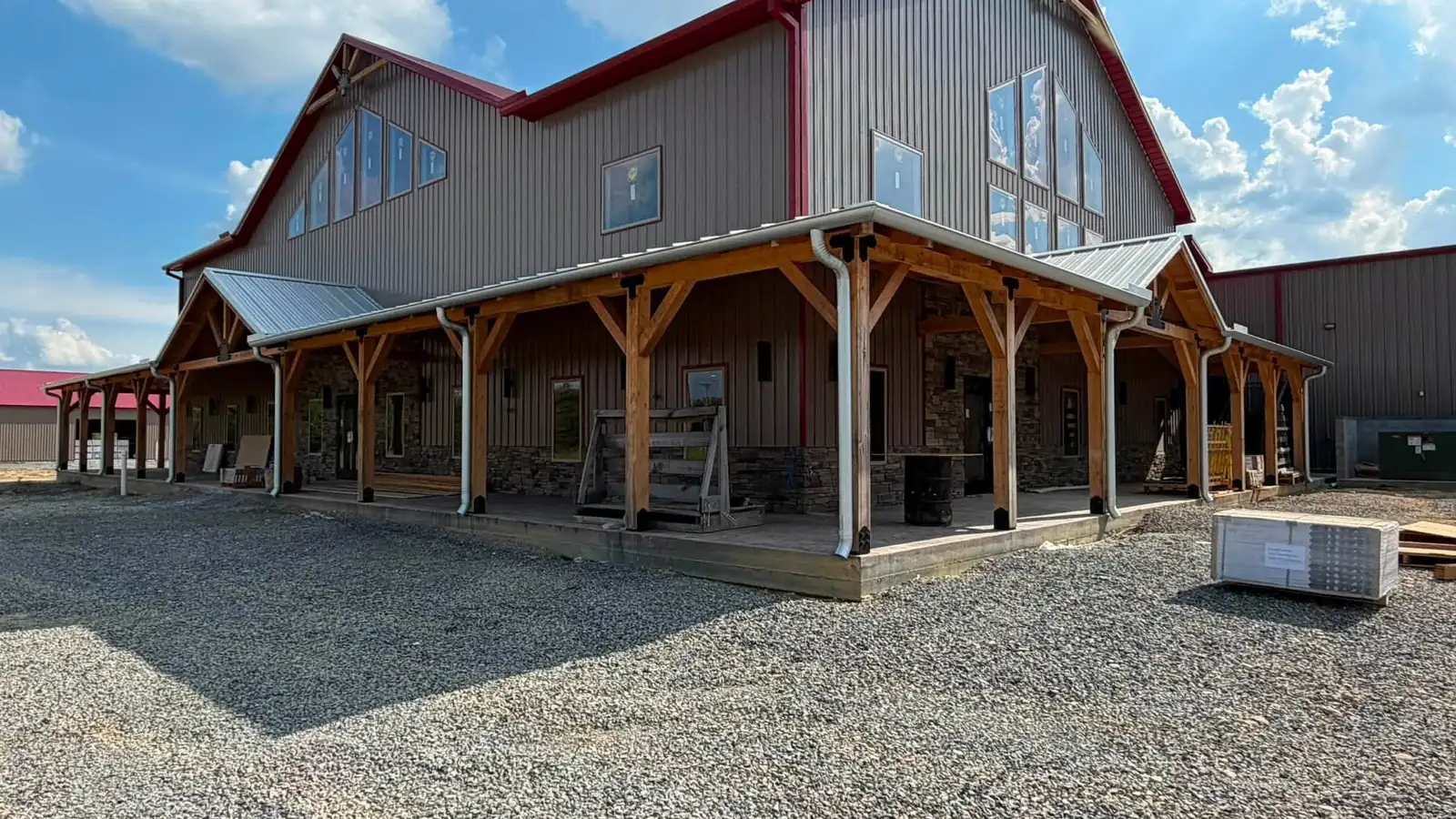
Commercial Gutter Installation in Chattanooga, TN
Installation and replacement for working commercial properties, from shops and workshops to barns and metal buildings. The gutter gets sized to the roof draining into it, not to whatever happens to fit the fascia.
Commercial Gutter Systems and the Buildings They Go On
A commercial roof is not a house roof at a larger scale. It sheds off a broader plane, funnels the water into fewer places, and puts it down where your business is operating. A system that would suit a house can be the wrong specification for a shop with the same footprint.
So commercial gutter systems get specified for the building in front of us rather than scaled up from a residential one. What size the gutter has to be, how many outlets it takes and where those outlets are allowed to go all follow from the roof and from the way the property is used.
We also fix to whatever the building gives us. A house offers a wooden fascia the full length of the eave. A metal building or pole barn often offers none at all, just the roof edge and the trim behind it. That gets settled on site, not assumed from a drawing.
Large-Capacity Gutter Systems and How One Gets Selected
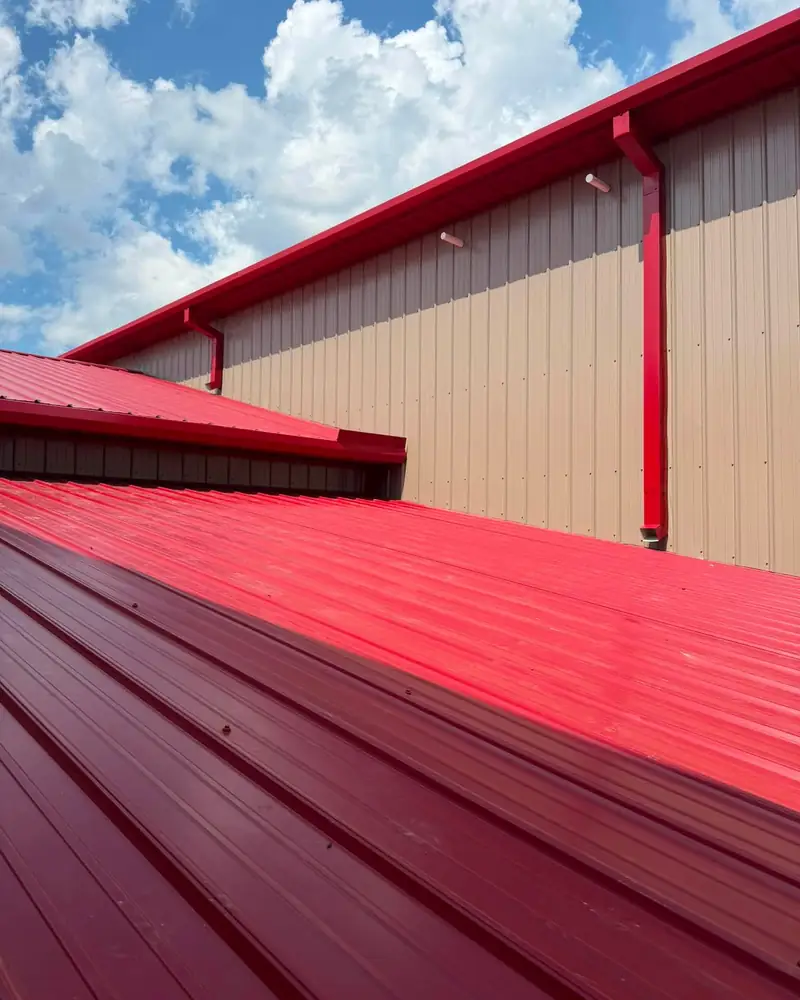
The gutter gets sized against the area of roof feeding it rather than the fascia board it hangs on. That is what large capacity means in practice: a bigger section, moving more water, to more outlets. Four things decide what we recommend.
How much roof drains into it. Whether the building sheds into one long side or splits across several, and how much roof area feeds each section.
Where the runoff concentrates. Valleys, pitch changes, lean-tos and additions funnel water into particular spots rather than spreading it evenly along the edge, and those spots decide where the outlets sit.
How many outlets it takes. More outlets on a long side means each one carries less, which is often a better answer than a larger gutter alone.
Where the water discharges. What each downspout empties onto, and where that water goes next. A system that collects well and discharges badly has only moved the problem a few feet.
Discharge is worth particular attention on a commercial property, where it can mean water crossing a doorway, a loading area that stays slick, or runoff sitting against a slab.
Materials for Commercial Systems
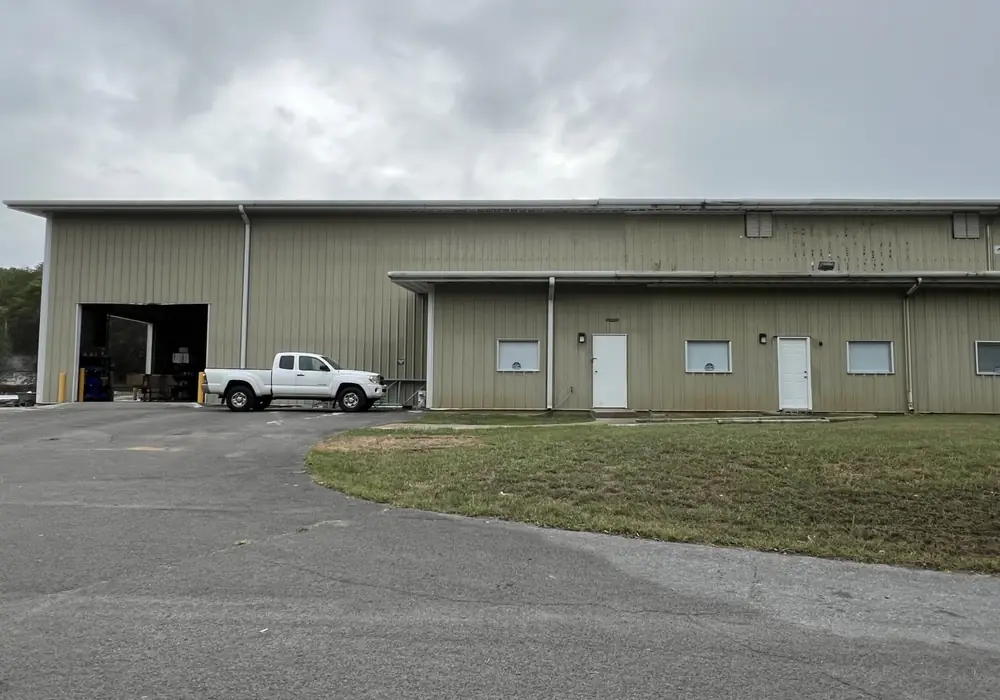
Aluminum does most commercial work. It is what the forming machine runs, so it can be rolled to length on site, and it holds a painted finish.
Steel and zinc are also fabricated and installed here: galvanized or Galvalume steel, and architectural zinc. Both are custom-fabricated to the dimensions the building needs. They are usually chosen for the setting rather than the look, such as an agricultural environment that is hard on a painted finish, or a building where the existing metalwork sets the standard to match.
Heavier metals weigh more, and over a long section that weight becomes something the fascia and framing have to carry, so it is worth raising at the walk-round rather than late on. Which metal suits a given building is part of what the assessment settles. For what each metal is and how it weathers, read copper and specialty gutters.
Commercial Gutter Replacement on a Building Still in Use
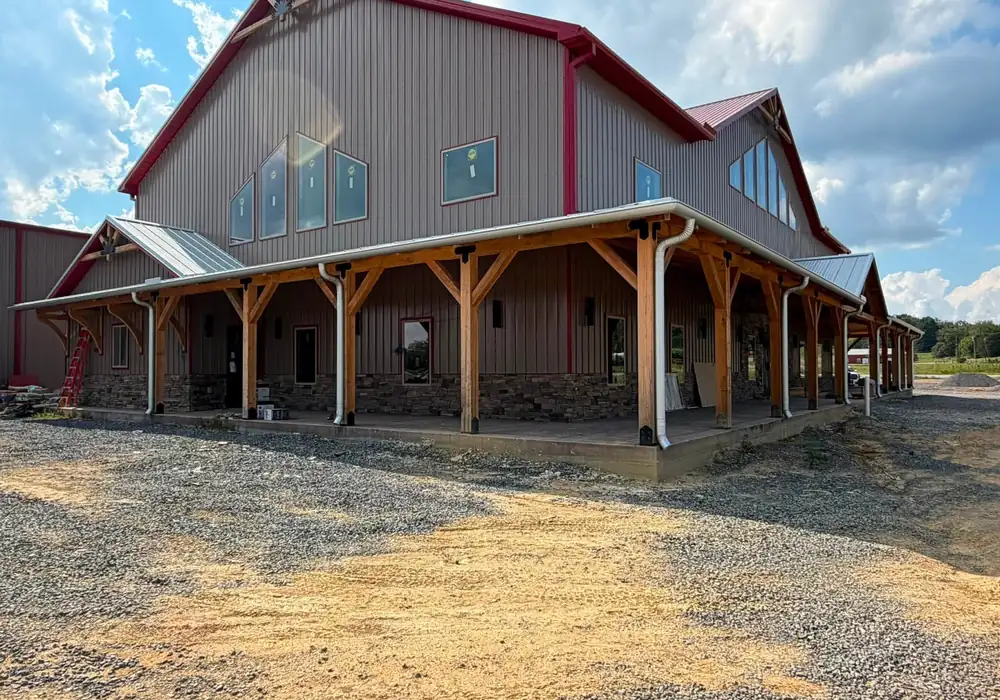
A replacement starts with taking the old system down, which is when the roof edge and whatever the gutter was fixed to become visible. On a metal building or pole barn that is often trim rather than a wooden fascia, so what the new system fixes to gets settled at that point rather than assumed beforehand.
Old outlet positions do not have to be reused. If water has been discharging somewhere awkward, across a doorway or onto a parking area, the replacement is the opportunity to move it.
Taking the old material down is part of the job. Where it ends up afterwards is agreed when we quote, since on a long commercial roofline there can be a lot of it.
Project Coordination Around a Working Property
Most of the difficulty on an occupied building is not the gutter. It is working around what the property is doing while we are there.
Entrances and doorways. Ladders and the forming setup need space along the wall, which can sit across a door customers or staff use. Tell us which entrances have to stay usable and we will sequence around them where the job allows.
Parking and yard space. The forming machine needs a stretch of level ground long enough to run finished lengths out, and part of the lot comes out of use while we work that side of the building. Knowing in advance which bays or loading areas matter most changes where we set up.
Your operating hours. Tell us when the building is busy and which areas have to stay clear. We will work to that where the job allows it, and it is worth saying early rather than late, because it can change how the work is sequenced.
Noise and access. There is noise, and the work moves along the building rather than happening everywhere at once, so it is usually a matter of keeping one stretch clear at a time.
We plan around how the property is used, but we cannot promise a job with no disruption at all. What we can do is tell you what each stage needs before it starts, so nothing on your side gets found out on the day.
Commercial Gutter Installation Questions
How do you determine what a building needs?
By walking it. The roof gets measured, the valleys and pitch changes get noted, and we look at where water is landing now and what is underneath it.
Expect as many questions about the ground as about the roof: doors, traffic, where vehicles park and what the lot gets used for.
Can you quote from plans or photos?
Plans are a useful start, particularly on a new build, and photos help us understand what we are coming to. Neither gets you a final number on its own.
Drawings do not show how the ground falls, where the gravel washes out or which door everybody actually uses, and those are the things that move an outlet.
Can you work around the hours we are open?
Usually. Tell us when the building is busy and which areas have to stay clear, and we will work to that where the job allows it.
Worth saying early rather than late, because it can change how the work is sequenced.
Can a system be replaced while the building stays in use?
Generally yes. The work moves along the building rather than happening everywhere at once, so it is usually a matter of keeping one stretch clear at a time rather than shutting anything down.
Can steel or zinc be used instead of aluminum?
Yes. We fabricate and install galvanized or Galvalume steel and architectural zinc, custom-made to the dimensions the building needs. Which one suits a given building depends on the setting and on what the existing metalwork is, and the extra weight over a long section is something the fascia and framing have to carry, so bring it up early and we will work out what fits.
Start on copper and specialty gutters and raise it when you get in touch.
Something specific to your building?
Tell us about it on the phone and we will work it out.
423-762-5904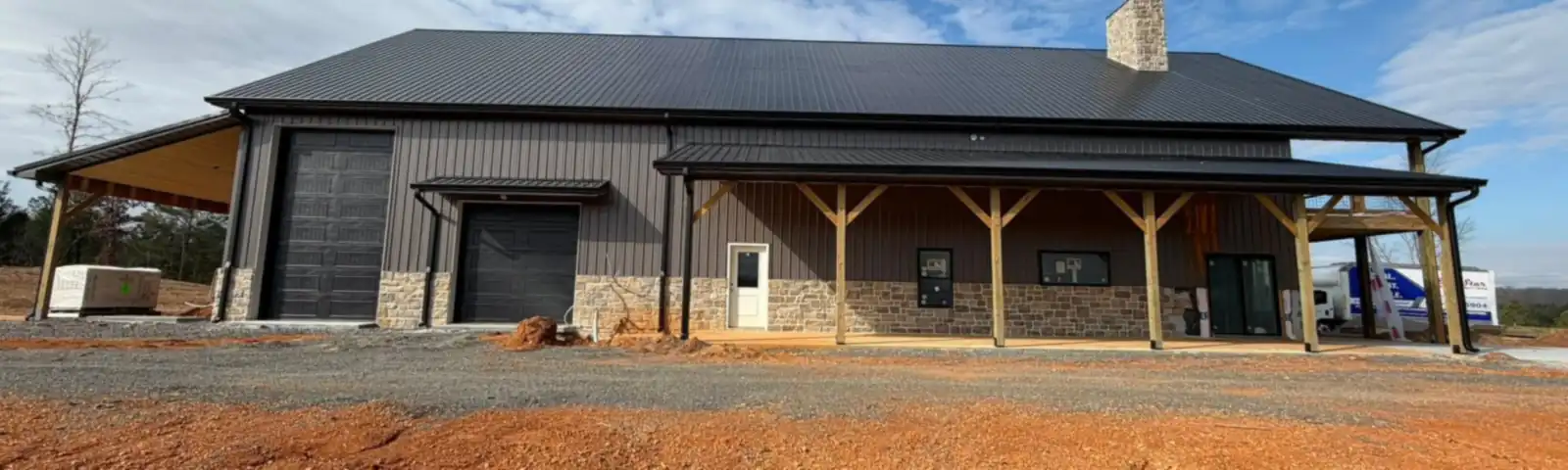
Request a Commercial Gutter Estimate
Tell us what the building is and how it gets used. We will come and look at the roof before putting a number on it.
Or call 423-762-5904